Categoria: Accountability
O Movimento de Combate à Corrupção Eleitoral sob o prisma da accountability
“Governance and the Law” é tema de Fórum Virtual promovido pelo Banco Mundial para elaboração de seu Relatório 2017
A participação de pesquisadores brasileiros é importante para os debates, para compartilharmos nossas experiências e também conhecermos a perspectiva de vários outros países.
|
GPSA Knowledge Platform – Upcoming E-Forum
|
|||||||||||||||||||||
|
Engaging with Citizen Voices and Experiences: The 2017 World Development Report on Governance and the Law
With Stephen Commins, Carolina Cornejo,Lucia Nass, Joy Aceron and Janet Oropeza
|
|
||||||||||||||||||||
|
About the E-Forum
|
|||||||||||||||||||||
|
This 3-week E-forum will be held on the GPSA Knowledge Platform and will consist of an online discussion where multiple stakeholders are expected to share their views, knowledge and experiences in the field of governance and the law, including ways in which different practitioners seek to promote governance reforms and strengthen the responsiveness of legal systems.
The World Development Report 2017 on Governance and the Law seeks to understand how governance interventions can be more effective in generating sustainable welfare improvements in the long term, and self-reinforcing dynamics of inclusion. Typically, policy discussions and technical advice consider issues such as coverage and quality of education, provision of health services, investment climate, etc. to explain development performance. However, interventions to improve these abovementioned factors can fail if the underlying determinants, which constrain sustainable progress, are not first addressed. This refers to the way in which institutions are shaped, legitimized and equipped to deliver on such goals. Our understanding of policy options to address these underlying determinants, which are crucial for countries to achieve key development outcomes like growth, equity, and security, is lacking. In this context, the Report seeks to unpack the complex interactions between state institutions, power, social norms, and development outcomes to (i) explain cross-country (and within-country) heterogeneity and (ii) investigate processes of institutional change. By understanding better these interactions and these underlying factors, governance reforms may yield better outcomes.
The WDR 2017 team will utilize e-forum participants’ contributions as follows: (a) to have a reality-check on the WDR’s framework and main concepts; and (b) to identify specific country/case experiences that can be used to illustrate content of the Report.
This e-forum is one means through which the WDR 2017 will engage with external stakeholders working on governance issues. Over three weeks (from October 19 to November 6), this e-forum will aim to:
· Identify daily experiences and challenges of citizens with governance and the law;
· Reflect on the various factors that influence the quality of governance and the law in specific situations;
· Share good practices of engagement between civil society organizations and governmental agencies and ways to promote reforms in governance.
|
|||||||||||||||||||||
|
|
About the Facilitators
Stephen Commins is Associate Director, Global Public Affairs and Lecturer in Regional and International Development, at the Luskin School of Public Affairs, UCLA. He works with the WDR2017 team on external consultations and has written extensively on accountability and basic service delivery.
|
||||||||||||||||||||
|
|
Carolina Cornejo is Project Coordinator on Oversight Institutions at the Civil Association for Equality and Justice (ACIJ), a non-profit organization aimed at defending disadvantaged groups and strengthening democracy in Argentina.
|
||||||||||||||||||||
|
|
Lucia Nass is an independent consultant specialising in empowering local governance processes. She has gained over 25 years of experience in a variety of sectors, including agriculture, water and sanitation, rural energy, rural roads and pro-poor tourism. She is committed to gender mainstreaming.
|
||||||||||||||||||||
|
|
Janet Oropeza is the Knowledge Management Coordinator at Fundar, a civil society organization aiming to advance substantive democracy in Mexico. Janet has conducted research on governance, citizen participation, accountability, gender and human rights. Her areas of expertise also include knowledge exchange and online facilitation.
|
||||||||||||||||||||
|
Joy Aceron is Program Director at School of Government-Ateneo de Manila University directing Political Democracy and Reforms (PODER) and Government Watch (G-Watch). She has been involved in grassroots citizen monitoring of service delivery, procurement and program implementation of the government since 2004.
|
|||||||||||||||||||||
|
In order to participate in the E-forum, you will need to be registered to the GPSA Knowledge Platform and logged in. Create your account here.
|
|||||||||||||||||||||
|
|
|
|
|
|
|||||||||||||||||
Até 26 de Outubro de 2015 – Submissão de Trabalhos para a 12a Conferência Internacional da ISTR – The Third Sector in Transition: Accountability, Transparency and Social Innovation
O evento acontecerá em Estocolmo, na Suécia, de 28 de Junho a 01 de Julho de 2016
12th International ISTR Conference
Deadline for Submissions – 26 October 2015
The Third Sector in Transition:
Accountability, Transparency, and Social Innovation
- The Third Sector and the Welfare state
- Civil society and Democracy
- NGOs and Globalization
- Accountability and Transparency
- Social Innovation and Social Enterprise
- Advocacy and Public Policy
- Philanthropy and Foundations
- Volunteerism and Co-production
- Managing Third Sector Organizations
- Emerging Areas of Theory and Practice
Observação: o limite de 500 palavras não inclui as referências.
Webinar “Can citizen empowerment improve people’s lives? Evidence from the Transparency for Development program” – October 6th
|
OGP Webinar:
“Can citizen empowerment improve people’s lives? Evidence from the Transparency for Development program”
Tuesday, October 6th, 2015
Speakers:
Nathaniel Heller Managing Director – Results for Development Institute (R4D) Courtney Tolmie
Senior Program Director – Results for Development Institute (R4D) Sponsored by the OGP Support Unit and the World Bank
Description:
Much has been made of the potential of bottom-up accountability as a pathway to improve governance and development outcomes; however there is less consensus regarding what “bottom-up accountability” means, how to achieve it, and how effective it is in improving health, education, and other outcomes that affect people’s livelihoods.
The Transparency for Development program – led by Results for Development Institute and the Harvard Kennedy School – is a mixed-method multi-country design and evaluation program that is seeking to answer these questions. Working with civil society organizations in Tanzania and Indonesia, the program has designed a mechanism for engaging with and empowering citizens to hold service providers and local governments accountable for providing better health services, specifically in maternal and neonatal health. Using quantitative and qualitative evaluation approaches, including both ethnography and randomized control trials, the program is currently measuring the success and bottlenecks of achieving bottom-up accountability from the community level that translates to healthier mothers and babies.
This webinar will highlight the components of the Transparency for Development program, including early findings from the pilot in Tanzania and Indonesia. The speakers will further discuss the implications of this research on assessing the effectiveness of bottom-up accountability across other sectors, and for policymakers at the sub-national and national levels seeking to leverage open government and transparency efforts towards improved delivery of public sector services.
Speakers:
This session’s recording will be available on the OGP website, as well as in the World Bank’s E-Institute portal where you can also find the recordings of all the other OGP Webinars.
To JOIN the session on Tuesday, October 6, 2015 at 10:00 a.m. EST, please go HEREand login 5 minutes before the webinar is scheduled to start. Please note that you will receive confirmation from AdobeConnect after you register.
|
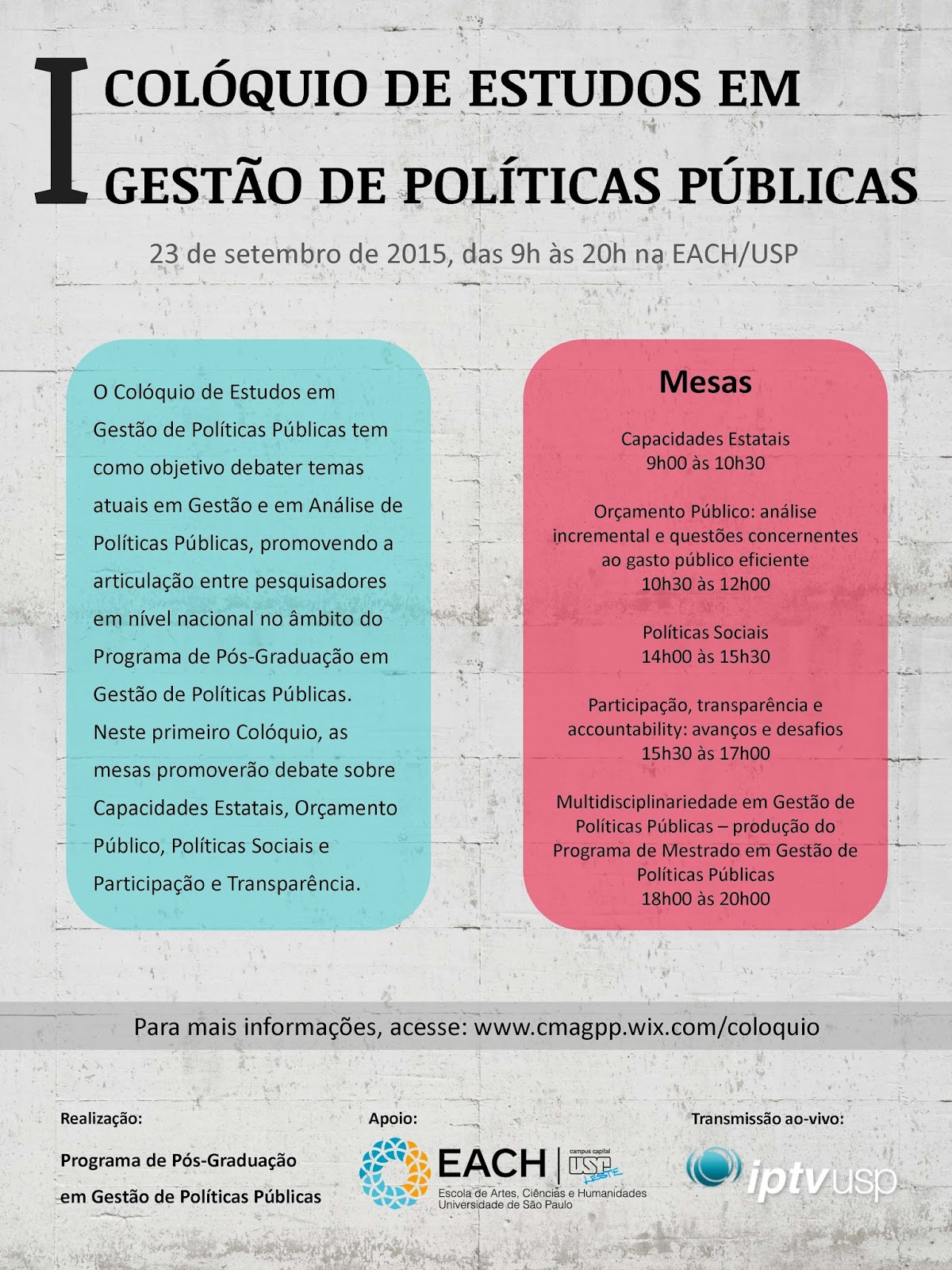
I Colóquio de Estudos em Gestão de Políticas Públicas da EACH/USP acontece no próximo dia 23
A mesa Participação, transparência e accountability: avanços e desafios será moderada pela professora Patricia Mendonça, da USP/EACH, contando com:
Cecilia Olivieri – USP/EACH – Programa de Pós-Graduação em Gestão de Políticas Públicas
Eduardo Pannunzio – FGV – Centro de Pesquisa Jurídica Aplicada da Escola de Direito
Marco Antonio Carvalho Teixeira – FGV/EAESP – Departamento de Gestão Pública
Paula Chies Schommer – UDESC/ESAG – Grupo de Pesquisa Politeia
Inesc convida para lançamento oficial dos resultados do Índice de Orçamento Aberto 2015
Lançamento oficial dos resultados do Índice de Orçamento Aberto 2015 será nesta sexta-feira (11/9), na Controladoria Geral da União (CGU), em Brasília, a partir das 9h30.
No entanto, o Brasil ainda precisa melhorar alguns aspectos, como a abrangência do seu Projeto de Lei Orçamentária Anual (PLOA), apresentando mais informações sobre a classificação das despesas e receitas para anos futuros, e também a abrangência do Relatório de Cumprimento de Metas. A pesquisa também sugere que o governo brasileiro providencie uma atualização oficial do seu Plano Plurianual (PPA) como um documento chave que tem que influenciar e orientar o orçamento anual e respeite o prazo estabelecido na legislação em relação ao ciclo orçamentário.
“No período de realização da pesquisa, o Congresso Nacional segurou a LDO 2014, gerando atraso no ciclo orçamentário. Outra questão que consideramos fundamental a ser aperfeiçoada é a participação social no processo de elaboração do orçamento: apesar de algumas iniciativas, como o Orçamento Cidadão, o orçamento ainda é distante da população em geral”, afirma Carmela Zigoni, assessora política do Inesc e responsável pelo Índice no Brasil. Ela lembra ainda que os espaços de participação disponíveis no Brasil não são decisórios, mas apenas consultivos. “E o governo não estimula de fato o engajamento real da sociedade nesse debate. A prova disso é que a participação social não é citada nos documentos do orçamento.”
“Outra questão a ser aperfeiçoada é a disponibilidade dos dados – todos os documentos estão em PDF, não em formatos reutilizáveis. Isso dificulta que os dados sejam utilizados por organizações interessadas em realizar o controle social. Se os dados do orçamento federal estão abertos em diversas plataformas, por que não abrir também os documentos aprovados?”
Em termos globais, o Índice de Orçamento Aberto 2015 aponta que 98 países pesquisados não têm sistemas apropriados para garantir que os recursos públicos sejam utilizados adequadamente, e 32 deles não satisfazem nenhum dos três critérios.
O Índice de Orçamento Aberto é elaborado desde 2006 e tem como princípio avaliar se o governo federal de cada país pesquisado disponibiliza ao público oito documentos-chave do orçamento. Além disso, investiga se os dados desses documentos são abrangentes e úteis. Os resultados são analisados por meio de um questionário de 125 questões, respondido por especialistas independentes, sociedade civil e membros da academia.
A pesquisa usa critérios internacionalmente aceitos, desenvolvidos por organizações multilaterais como o Fundo Monetário Internacional (FMI), Organização para a Cooperação e Desenvolvimento Econômico (OCDE) e Organização Internacional de Instituições de Auditorias. O processo de pesquisa levou cerca de 18 meses, entre março de 2014 e setembro de 2015, envolvendo cerca de 300 especialistas de 102 países.”
Fonte: Comunicação Inesc <comunicacao@inesc.org.br>